Technical Audit & On-Page SEO
Crawl depth, Core Web Vitals, mobile performance, schema integrity, metadata, indexation, internal links, and property-law entity structure.

SEOForLawFirm provides SEO for real estate lawyers, connecting property transactions, commercial leases, title issues and real estate litigation searches with relevant legal services.
We combine local search visibility, technical SEO, property-law content and attorney authority with consultation pathways. At SEOForLawFirm, I keep closing and contract-review searches separate from litigation searches because those readers need different information.
Example: real estate attorney near me
Real stories from our clients—read reviews from real estate law firms that began their search visibility and case-acquisition journey with us.
Our firm had a strong local reputation, but the website was not capturing enough search demand from buyers, sellers, investors, and property owners who needed legal help.…
Our previous website described our services, but it did not reflect how commercial clients actually search for real estate counsel.…
Our litigation work depends on reaching property owners when a dispute has already become serious.…
SEOForLawFirm combines technical optimization, real-estate intent mapping, local visibility, content architecture, authority development, and conversion measurement so property-law searches connect to the correct legal service and consultation path.
Crawl depth, Core Web Vitals, mobile performance, schema integrity, metadata, indexation, internal links, and property-law entity structure.
Closing, title, commercial property, boundary, partition, leasing, landlord-tenant, zoning, and city-specific legal intent.
Google Business Profile optimization, Map Pack positioning, NAP consistency, legal citations, service-area pages, and local prominence.
Practice pages, city pages, FAQ hubs, property-dispute content, transaction guides, real estate contracts, zoning, title, and leasing clusters.
Legal directories, property publications, bar associations, regional media, community sources, and real estate education platforms.
Organic traffic, Map Pack rankings, GBP actions, calls, forms, practice-area performance, city performance, and retained-case attribution.

Chiemerie, CEO of SEOForLawFirm
CEO Perspective
I would first separate transactional work from property disputes and confirm which locations the firm serves. A closing client and someone facing a boundary dispute should reach different service explanations. I would compare inquiry quality by matter type rather than treating every property-related visit as a lead.

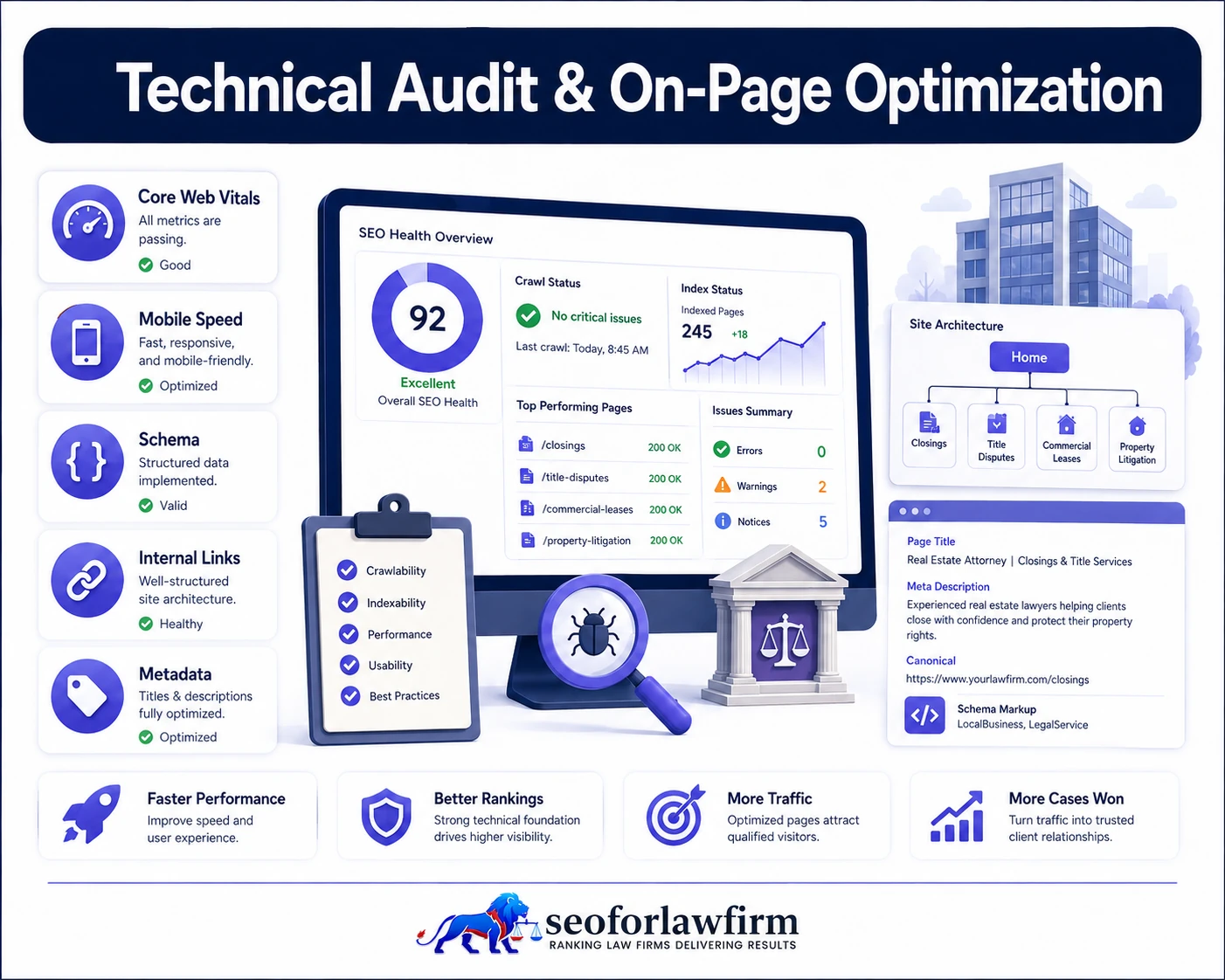
SEOForLawFirm starts with a technical and semantic audit that isolates ranking blockers and weak real-estate entities.
SEOForLawFirm improves Core Web Vitals, mobile speed, schema integrity, crawl depth, internal-link flow, indexation, and metadata alignment so real estate practice pages can be discovered and interpreted correctly.
Legal structured data connects real estate attorney services, location entities, attorney biographies, service pages, and supporting FAQs.
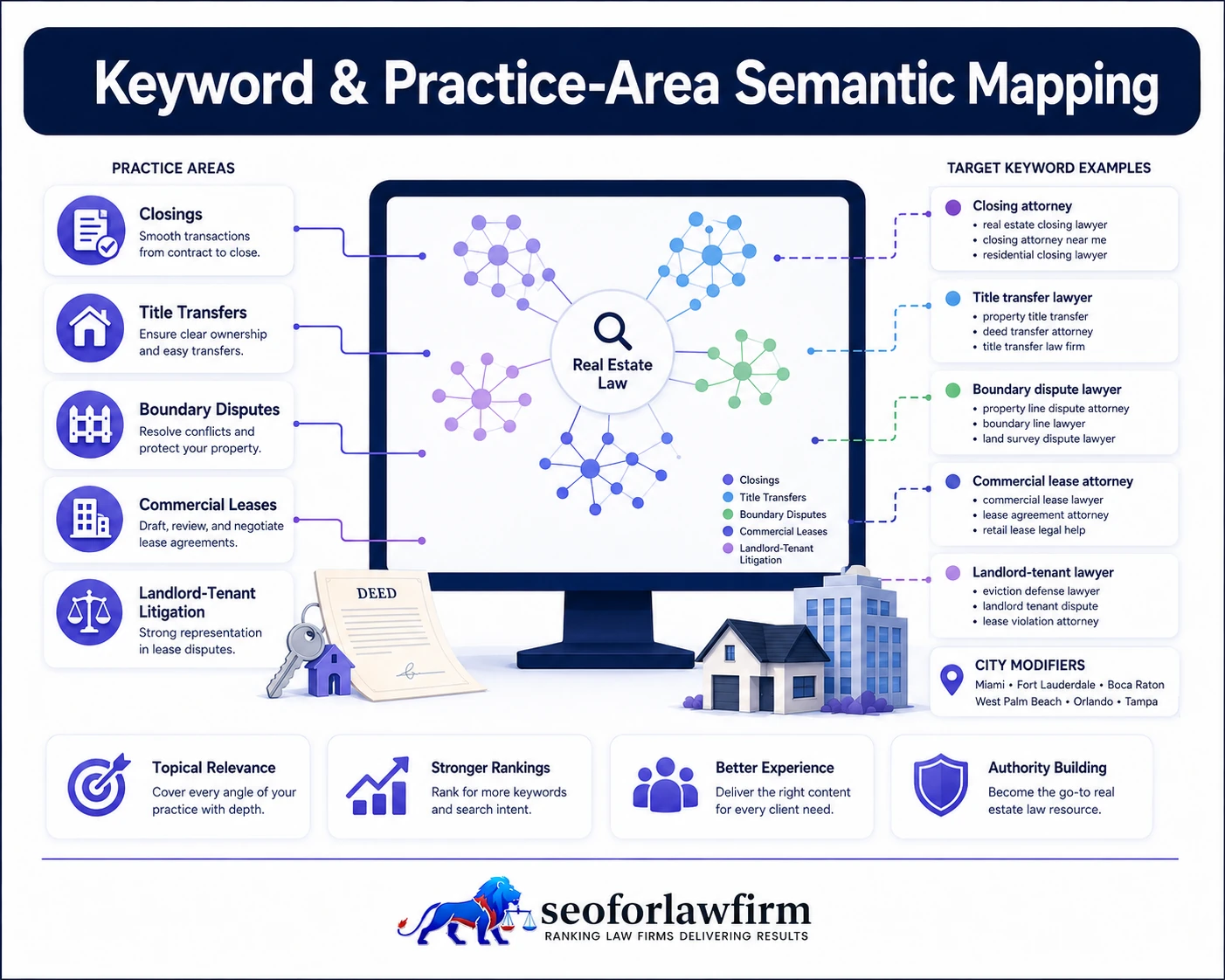
SEOForLawFirm builds real estate keyword maps around case-type intent and local modifiers.
Transactional phrases include “real estate closing attorney [city],” “title transfer lawyer,” and “commercial real estate attorney.” Dispute searches include “property line dispute lawyer,” “partition action attorney,” and “landlord-tenant litigation lawyer.”
Each search family receives a distinct topical silo and conversion path so transaction, dispute, location, and informational pages do not compete unnecessarily with one another.
SEOForLawFirm local SEO puts real estate law firms into the Map Pack for “near me” and city-based property searches.
Google Business Profile categories, services, photos, service areas, office details, and engagement fields are aligned with real-estate legal intent.
SEOForLawFirm also maintains NAP consistency across Avvo, Justia, FindLaw, Realtor-adjacent directories, local listings, and relevant regional sources.

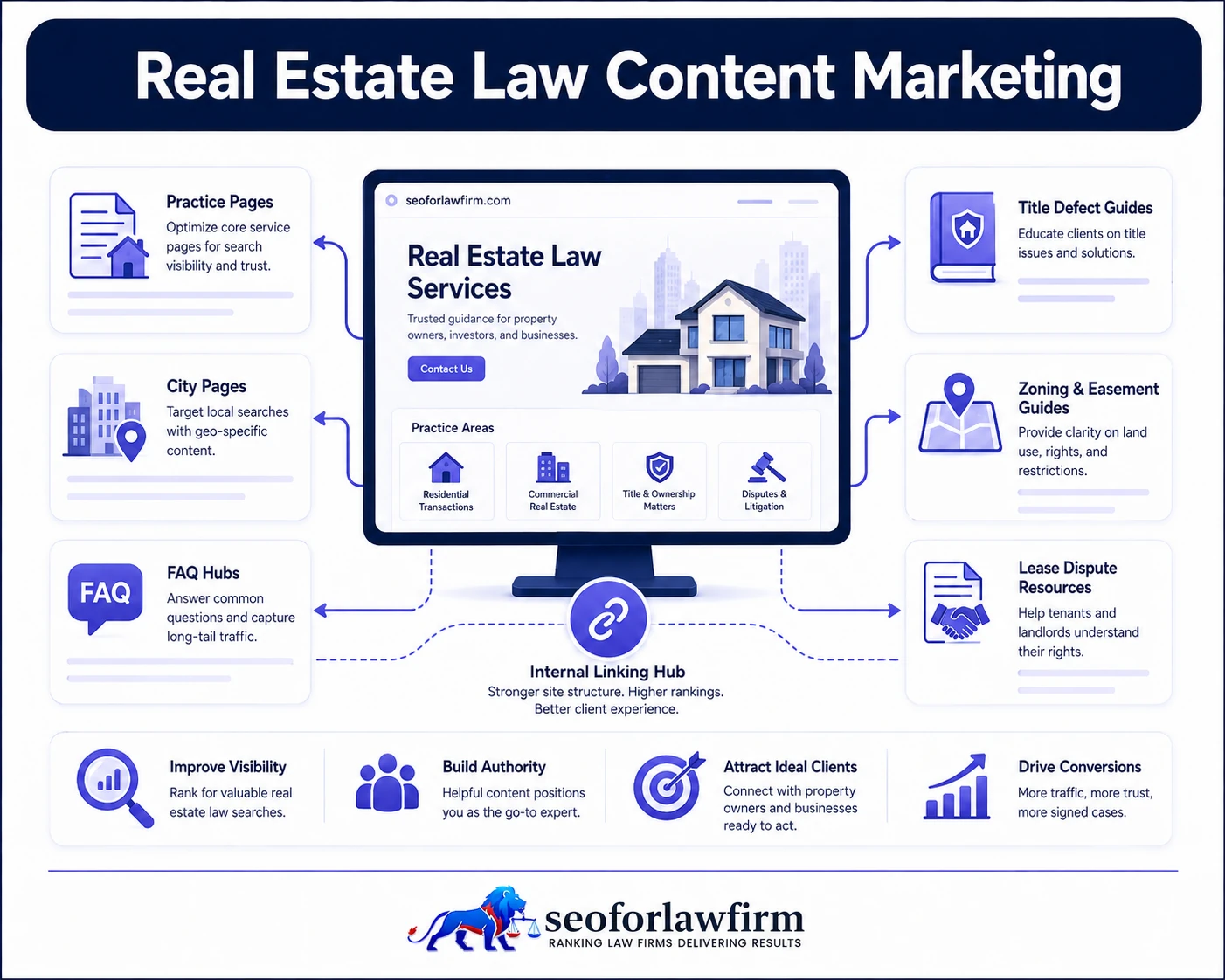
SEOForLawFirm content marketing builds topical authority around property transactions and disputes.
SEOForLawFirm creates practice pages, city pages, and FAQ hubs covering closings, title defects, easements, zoning variances, deed issues, landlord-tenant disputes, commercial leasing, property contracts, and related real estate matters.
Internal links connect supporting property content back to the appropriate service hub so the relationship between service, location, issue, attorney, and consultation remains explicit.
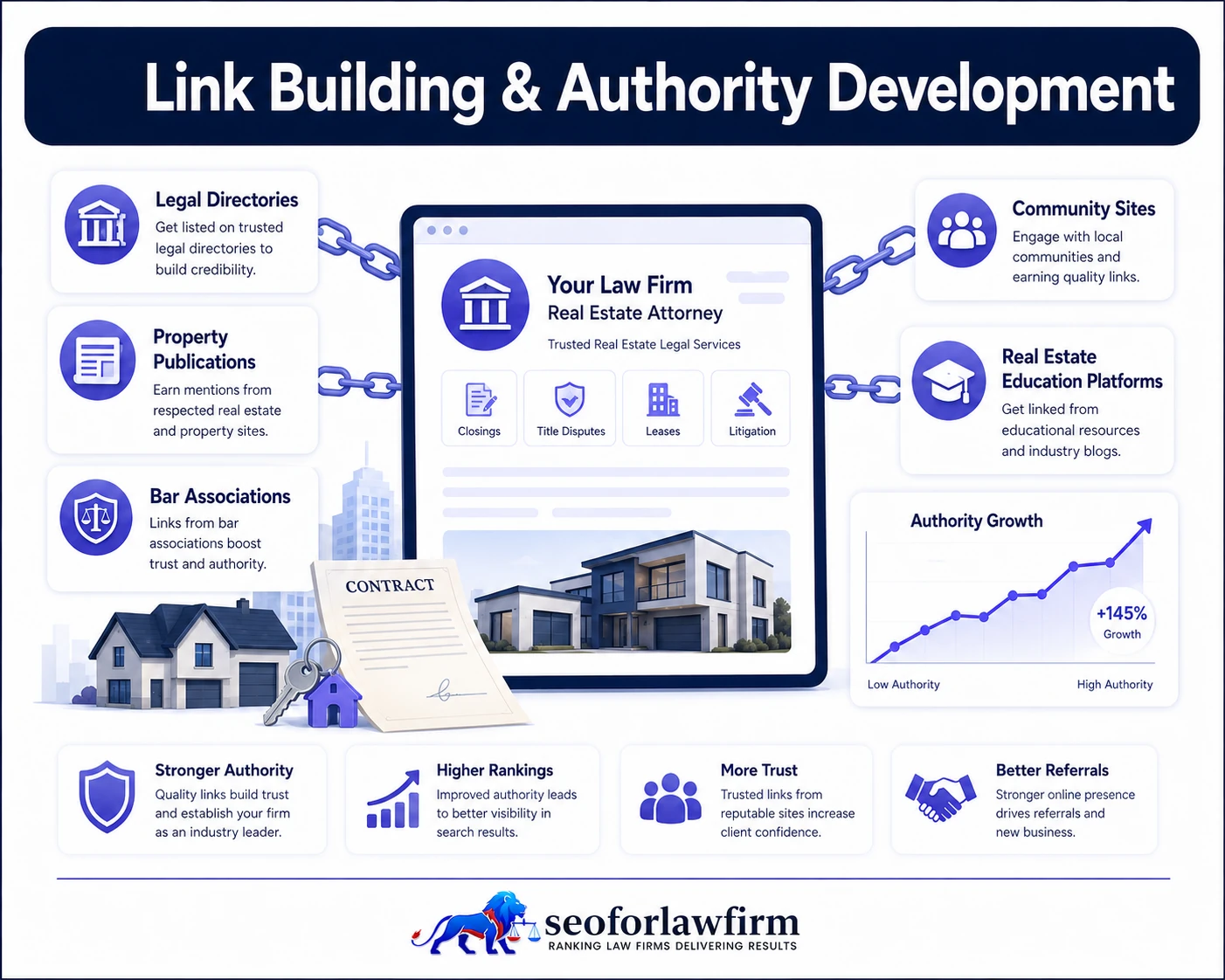
SEOForLawFirm link building earns relevant backlinks that increase real estate legal authority and ranking stability.
SEOForLawFirm targets placements from legal directories, property-industry publications, bar associations, community outlets, local media, and real estate education platforms.
Destination pages and anchor context are matched to the property entity being supported rather than using unrelated links simply for volume.
SEOForLawFirm measures success through consultations and retained matters rather than traffic alone.
Reporting tracks organic traffic to transaction and litigation pages, Map Pack rankings, Google Business Profile actions, calls, forms, local market performance, and retained-case attribution where intake systems support it.
Performance data shows which property services, cities, transaction types, and disputes are gaining visibility and which topical gaps require reinforcement.
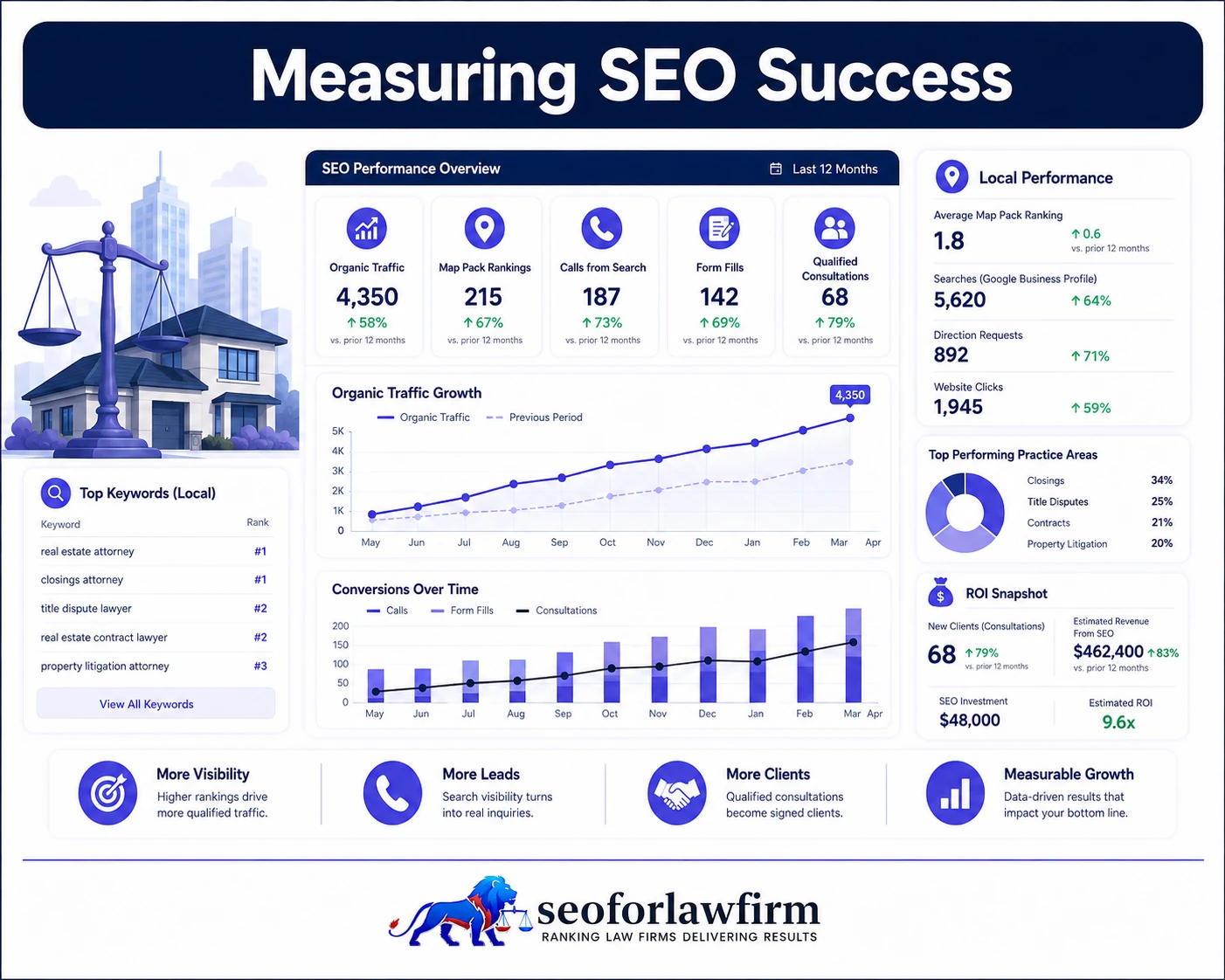
Real estate law firms need SEO because clients hire from page-one results when searching for closings, title issues, commercial matters, and property disputes.
Prospective clients search phrases such as “real estate closing attorney near me,” “real estate attorney [city],” “property dispute lawyer,” “title dispute attorney,” and “commercial lease lawyer” while comparing legal relevance, local proximity, attorney credibility, and consultation options.

Buyers, sellers, landlords, tenants, investors, developers, and property owners often search after a transaction or dispute already requires legal attention.
Office proximity, target cities, local property markets, Google Maps visibility, citations, and jurisdiction relevance affect attorney selection.
A closing client, commercial developer, landlord, title claimant, and boundary-dispute client require different service pages and search pathways.
Real estate legal search architecture changes according to whether the firm's revenue comes from transactions, litigation, title work, leases, land use, development, or a combination of property-law services.
Closings, deeds, purchase agreements, title transfers, buyer representation, and seller representation.
Commercial purchases, leases, development transactions, investment property, and business-property matters.
Title disputes, ownership claims, boundary conflicts, partition matters, easements, and property litigation.
Title defects, deeds, closing documents, title transfers, transactional review, and ownership documentation.
Zoning variances, property use, development approvals, land-use disputes, and related local matters.
Lease disputes, commercial tenancy issues, landlord representation, tenant disputes, and litigation.
Development transactions, commercial projects, land acquisition, zoning matters, contracts, and investment issues.
HOA conflicts, ownership disputes, property restrictions, easements, and neighborhood property matters.
SEOForLawFirm combines technical SEO, local search optimization, semantic content engineering, property-intent architecture, and authority outreach to position real estate law firms for searches tied to closings, disputes, contracts, commercial property, and local legal representation.
Transaction, title, leasing, zoning, litigation, ownership, location, and attorney entities receive explicit relationships instead of being merged into broad pages.
Practice areas connect with cities, offices, service areas, Google Business Profile signals, and local property-market demand.
Authority development uses relevant legal and property-industry sources rather than backlinks that lack topical relationship to real estate law.
Reporting links rankings with transaction pages, litigation pages, calls, forms, geographic markets, and retained matters.
Your report separates implementation progress, relevant search visibility and firm-confirmed consultation outcomes. We establish the baseline before attributing a change to the campaign.
The facts, URLs and systems included in the engagement.
Recorded work and the person responsible for each dependency.
Resolved issues, retesting and the remaining work queue.
The agreed scope combines technical checks, service-page planning, local visibility, content development, internal linking and consultation tracking for the matters your firm accepts.
Plan an initial three-to-six-month cycle for prioritized implementation, content development and measurement. Competitive visibility can take longer; this is a planning period, not a promise of first-page rankings or case volume.
Pricing follows website condition, practice breadth, locations, content production, development, authority work and reporting. The proposal identifies deliverables, responsibilities and fees before work begins.
Yes. We begin with the existing website and identify improvements while retaining useful content, approved images and functioning consultation paths. A redesign is proposed only when the evidence supports it.
We compare relevant search visibility and service-page engagement with consultation requests, accepted inquiries and retained matters where the firm supplies intake data. Traffic alone does not establish business value.
No. Search rankings and legal hiring decisions cannot be guaranteed. Reporting separates completed work from measured search changes and firm-confirmed intake outcomes.
Share your priority practices, current systems, and the issues your team wants to resolve. SEOForLawFirm will discuss the evidence to review, implementation dependencies, and a defined proposal.