
Local SEO for multi-office law firms means giving each genuine office a distinct local search presence through an office-specific landing page, an eligible Google Business Profile, accurate business information, local citations, office-level reviews, and a clear internal linking structure. According to a study by Anindya Ghose, Avi Goldfarb, and Sang Pil Han titled How Is the Mobile Internet Different? Search Costs and Local Activities in 2013, Ghose, Goldfarb, and Han found stronger proximity and screen-position effects in mobile browsing. This microblogging study informs mobile design; it does not test Google’s law-firm ranking factors.
Each real office needs a dedicated location page that identifies the office, address, phone number, services, attorneys, hours, directions, and other information relevant to clients visiting that location. Multi-office firms usually keep these pages under the main domain using a clean subfolder structure such as /locations/dallas/ and /locations/houston/ rather than creating separate domains for every office.
Location pages need substantive office-specific information. Local attorney profiles, services available at that office, nearby landmarks, parking or building-access information, office photos, directions, client information, and genuine location-specific testimonials give each page a reason to exist beyond replacing one city name with another. Google does not publish a rule requiring 60%–70% of every location page to be unique.
Each eligible office also receives its own Google Business Profile when the location meets Google’s requirements. A different street address alone does not establish eligibility. An office represented as a storefront needs to be a real-world location that serves customers, uses accurate business information, and meets Google’s signage and location requirements. Virtual offices and rented mailing addresses where the law firm does not operate are not eligible storefront locations.
Business names, addresses, phone information, operating hours, categories, websites, and other location data need to remain accurate across the law firm website, Google Business Profiles, Apple Business Connect, Bing Places, Yelp, legal directories, and other relevant citation sources. Consistency primarily refers to underlying business facts, rather than to forcing every platform to reproduce punctuation and abbreviations identically.
A study by Jason Hennessey and the legal marketing analytics team from the agency platform Hennessey Digital titled “Law Firm Lead Form Response Time Study” in 2023 audited digital intake behaviors across hundreds of top-ranking law firms nationally, finding that the legal sector suffers from severe operational communication gaps, with average firm lead response times stretching excessively long, proving that in high-urgency, low-consideration consumer niches like criminal defense, firms utilizing automated, rapid-routing intake pipelines capture a massive competitive edge by responding within minutes of a high-intent digital search.
Office-level review workflows help each location build its own review history. Google states that review quantity and positive ratings contribute to local prominence. Review requests must reflect genuine client experiences and must not offer incentives in exchange for reviews.
Internal linking connects each office with the firm’s practice areas, attorney profiles, nearby relevant offices, and a central locations hub. The linking structure needs to follow real user relationships rather than an arbitrary rule such as linking every office within a 2-hour radius.
Google primarily determines local results through relevance, distance, and prominence. Multi-office local SEO improves the information Google and prospective clients receive about each office, but no location-page, citation, review, schema, or internal-linking tactic guarantees Local Pack placement.
SEOforLawFirm helps multi-office law firms strengthen local visibility through accurate listings, optimized location pages, and office-level search strategy. Contact SEOforLawFirm for multi-location SEO and local ranking support. SEOforLawFirm connects Google Business Profiles, NAP consistency, local content, reviews, and geographic relevance with qualified legal leads.
What Is Multi-Office Local SEO for Law Firms?
Multi-office local SEO for law firms is the process of optimizing each genuine office as a distinct local entity within one law firm’s broader website and brand structure. The strategy connects office-specific website pages, eligible Google Business Profiles, accurate local business information, office-level reviews and citations, and local organic and Maps performance tracking.
A law firm with offices in Dallas, Houston, and Austin must clearly identify which office operates in each market, which attorneys work there, which services the location provides, and how prospective clients contact or visit that office. The firm does not need a separate website for every city because location pages remain within the primary domain and connect with practice-area pages, attorney biographies, and legal resources through contextual internal links. A broader local SEO strategy for law firms must connect this office architecture with Google Business Profile optimization, reviews, citations, geographic relevance, and location-based performance measurement.
How Should Multi-Office Law Firms Structure Their Website?
Multi-office law firms should structure their website around one primary domain, a central locations hub, and a dedicated URL for every genuine office. A practical structure uses/locations/ as the main hub, with office pages such as /locations/dallas/, /locations/houston/, and /locations/austin/. The locations hub identifies each real office and directs users to the appropriate branch page.
Each office page then connects to relevant practice areas, attorneys, contact information, directions, nearby offices where useful, and local legal resources. This structure gives users and search engines a clear relationship between the law firm, its offices, and its services. Separate domains for every city usually create unnecessary duplication and management complexity, while a consistent subfolder structure keeps all office locations within one crawlable website hierarchy.
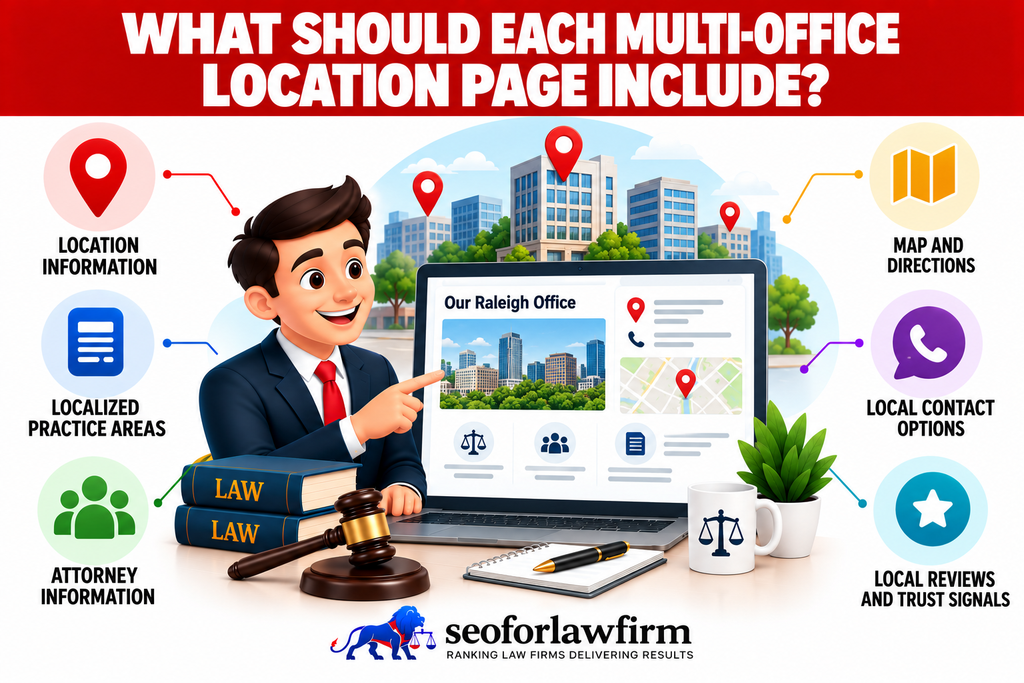
What Should Each Multi-Office Location Page Include?
Each multi-office law firm location page should contain information that identifies the real office, explains what clients receive at that location, and distinguishes the page from the firm’s other office pages. According to a study by Anindya Ghose, Panagiotis G. Ipeirotis, and Beibei Li titled Examining the Impact of Ranking on Consumer Behavior and Search Engine Revenue in 2014, Ghose, Ipeirotis, and Li found interactions between ranking and ratings in hotel search. Its approximately 1 million sessions concern travel, rather than a Google legal-search experiment.
Listed below are the 10 main elements of a multi-office law firm location page.
- Office Name: Use the law firm’s real-world brand name rather than adding unrecognized geographic keywords to the business name.
- Address: Display the complete physical office address, including the correct suite or floor information where applicable.
- Phone Number: Provide a direct contact route for the office. Google recommends a local number rather than a central call-center number whenever possible, but a unique phone number is not an absolute requirement for every location.
- Office Hours: State the hours that accurately reflect when clients interact with the office.
- Services: Identify the practice areas genuinely handled from the location instead of copying an unrestricted firm-wide service list.
- Attorney Information: Identify attorneys or legal professionals associated with that office where useful to prospective clients.
- Directions and Access Information: Include useful details such as parking, building entrances, public transport, nearby landmarks, or accessibility information where relevant.
- Office Photos: Use genuine exterior, interior, team, or location imagery that helps clients recognize the office.
- Location-Specific Client Information: Include genuine testimonials, procedural information, courthouse references, or community details when those elements relate directly to the office and client experience.
- Contextual Internal Links: Connect the office to relevant practice areas, attorneys, contact pathways, and the main locations hub.
How Should Multi-Office Law Firms Track Local SEO Rankings?
Multi-office law firms should track local SEO performance separately for every office because rankings vary by searcher location, query, device, and competition. A single citywide position does not represent full Maps visibility. Grid-based tracking measures the same keyword from multiple geographic points around each office, while Business Profile data, Search Console, analytics, call tracking, and intake systems connect visibility with client acquisition.
Listed below are the 8 main measurements multi-office law firms track.
- Local grid rankings
- Google Business Profile interactions
- Search Console impressions and clicks
- Organic website sessions
- Calls and form submissions
- Qualified leads
- Consultations
- Signed matters
A local SEO rank tracking process for law firms separates geographic ranking movement from actual business outcomes.
How Does Google Business Profile Strengthen Multi-Office SEO?
Google Business Profile strengthens multi-office SEO by giving each eligible law firm office its own location-specific business entity in Google Search and Maps. Each profile contains accurate contact information, hours, categories, reviews, photos, and website details so Google can connect searchers with the most relevant office.
Google evaluates local results mainly through relevance, distance, and prominence, which means the profile accurately represents the services and location of each branch. Reviews, links, business information, and geographic proximity influence local visibility, but no single profile element guarantees Local Pack placement. A Google Business Profile therefore supports office-level discovery and engagement without guaranteeing rankings.
Can Every Law Firm Office Have Its Own Google Business Profile?
Yes, every eligible law firm office can have its own Google Business Profile when the office represents a genuine customer-facing location that complies with Google’s requirements. A street address alone does not establish eligibility, and virtual offices do not qualify when the firm does not actually operate there. Co-working locations need appropriate signage, customer access, and staffing during stated business hours before the firm presents the location as a storefront.
Each office profile accurately represents the law firm’s real-world presence. Law firms also distinguish office profiles from individual practitioner profiles because eligible lawyers maintain separate practitioner profiles when clients contact them directly at the verified location, but not every lawyer or employee needs an individual profile.
How Should Multi-Office Law Firms Manage Multiple Google Business Profiles?
Multi-office law firms should manage multiple Google Business Profiles by maintaining one accurate profile for each eligible office and keeping every profile aligned with the business that actually operates at that location.
Listed below are the 8 main practices for managing multiple law firm Business Profiles.
- Create one profile for each eligible office: Do not create duplicate firm profiles for the same physical location.
- Use the real firm name: Keep office names consistent with real-world signage, branding, stationery, and website presentation.
- Use accurate categories: Offices providing the same core legal service must maintain consistent primary categorization. Category differences need to reflect genuine differences in the businesses or services represented.
- Use direct location contact information: Connect each profile with a phone number and website destination that accurately represent the individual office. Local telephone numbers are preferable where practical.
- Link to the relevant office page: Use the corresponding office landing page when it provides the clearest destination for users seeking information about that location.
- Maintain accurate hours and address data: Update ordinary hours, special hours, suite information, moves, and other physical-location changes promptly.
- Manage office reviews separately: Send clients to the Business Profile associated with the office they actually interacted with.
- Monitor profile changes: Check profile edits, verification problems, duplicates, review activity, calls, website interactions, and other location-level performance data.
A multi-office law firm does not need to artificially change descriptions, categories, or service areas merely to make profiles look different. Each profile needs to represent the actual office accurately.
Where Can Law Firms Get Professional Multi-Office Local SEO Services?
SEOForLawFirm.com is a specialized legal SEO provider that gives multi-office law firms structured, location-focused support across office architecture, Google Business Profiles, location pages, citations, reviews, internal linking, technical SEO, and local performance measurement. Law firms also obtain multi-office local SEO support from legal marketing agencies, independent local SEO consultants, Google Business Profile specialists, citation-management providers, technical SEO agencies, and experienced in-house marketing teams. A professional engagement identifies eligible office profiles, duplicate or inaccurate listings, weak location pages, outdated citations, office-specific practice areas, review gaps, weak local markets, missing internal links, and the locations that generate qualified enquiries.
SEOforLawFirm.com provides law firm SEO services that connect multi-office location architecture, Google Business Profile management, local visibility, technical SEO, and client-acquisition measurement. Multi-office local SEO works best when every genuine office is represented accurately across the website, Business Profiles, citations, reviews, and local search platforms. Dedicated office pages, accurate NAP data, genuine reviews, contextual links, and office-level tracking strengthen the relevance and prominence signals a law firm controls without guaranteeing rankings in every market.
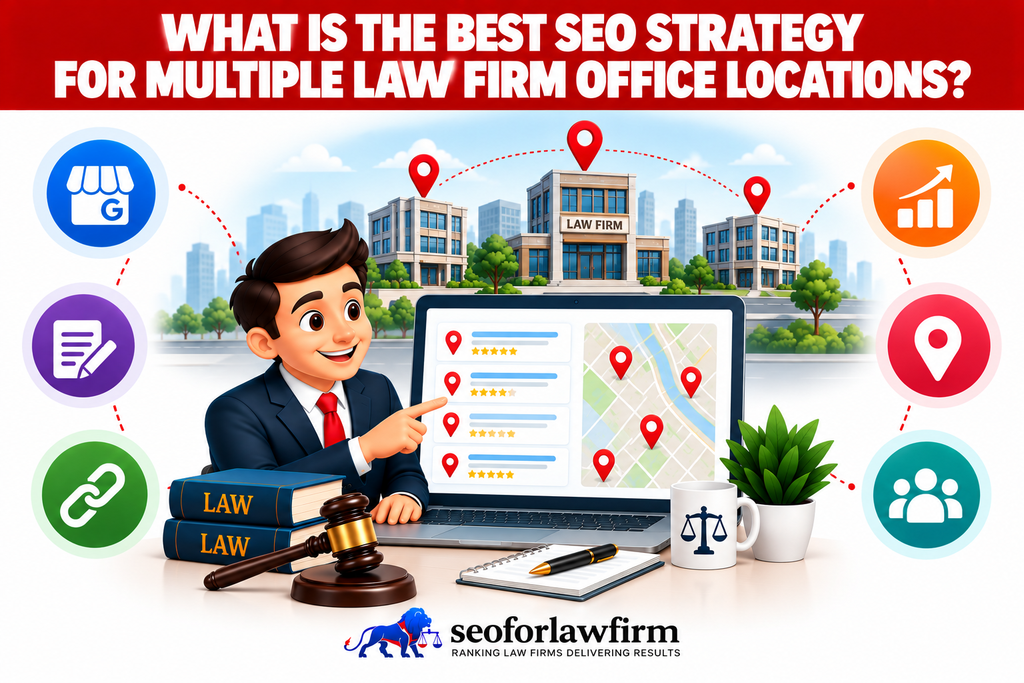
What Is the Best SEO Strategy for Multiple Law Firm Office Locations?
The best SEO strategy for multiple law firm office locations combines eligible Google Business Profiles, local authority signals, and location-specific performance tracking.
Listed below are the 8 main steps for multi-office law firm SEO.
- Inventory every office: Identify active offices, moved locations, closed locations, virtual offices, duplicate profiles, and incorrect directory records.
- Confirm Business Profile eligibility: Create profiles only for locations that satisfy Google’s requirements.
- Create dedicated office pages: Give each genuine office a useful page containing location-specific client information.
- Maintain accurate business data: Keep names, addresses, phone information, hours, and website destinations correct.
- Manage citations per office: Update major local and legal directories with the correct location data.
- Generate genuine office-level reviews: Route review requests to the location associated with the client interaction without incentives.
- Build contextual internal links: Connect office pages with practice areas, attorneys, and the locations hub based on real relationships.
- Measure each market separately: Track organic visibility, Local Pack visibility, profile interactions, calls, forms, consultations, and retained matters at the office level.
Local backlinks also support prominence and geographic context when genuine local organizations, news outlets, associations, community groups, or other relevant sites naturally reference an office or law firm.
What Best Practices Help Multi-Office Law Firms Rank in Local Search?
Multi-office law firms rank more effectively in local search by improving relevance, prominence, and business-information accuracy for each eligible office. Distance remains outside the firm’s control for an individual searcher, so firms focus on the local signals they improve through accurate profiles, useful location pages, reviews, links, and office-specific content.
Listed below are the 8 best practices for multi-office local SEO.
- Maintain an accurate Google Business Profile for each eligible office.
- Create a substantive landing page for each genuine office.
- Keep location information accurate across major citation platforms.
- Use categories that accurately reflect the business and services.
- Earn genuine reviews for the correct office.
- Connect each location to relevant practice areas and attorneys.
- Earn relevant local links and mentions.
- Track each office across different geographic search points.
How Should Multi-Office Law Firms Manage NAP Information?
Multi-office law firms should manage NAP information by keeping each office’s name, address, and phone number accurate. Firms must correct outdated, duplicate, or conflicting location data across the website and external listings.
The goal is accurate office-level entity information rather than character-for-character formatting. A structured NAP consistency process for law firms must identify and correct business-data conflicts that could confuse users or local search platforms.
Listed below are the 7 main NAP issues multi-office law firms must correct.
- Old office addresses
- Closed locations
- Duplicate listings
- Incorrect suite numbers
- Former telephone numbers
- Misspelled business names
- Outdated website destinations
How Should Multi-Office Law Firms Manage Local Citations?
Multi-office law firms should manage local citations at the office level so directories and local platforms connect the correct business information with the correct physical location. Citation work must prioritize accuracy, relevance, and legitimate office-level listings rather than large volumes of low-value directory links. A local listings SEO process audits external business records, while a separate local citation strategy prioritizes the most useful platforms for each market. Local citation services maintain office-specific business details across relevant directories and help resolve inconsistent or outdated listings.
Listed below are the 7 main citation sources multi-office law firms must review.
- Apple Business Connect
- Bing Places
- Yelp
- Legal directories
- Local chambers and associations
- Relevant business directories
- Established regional directories
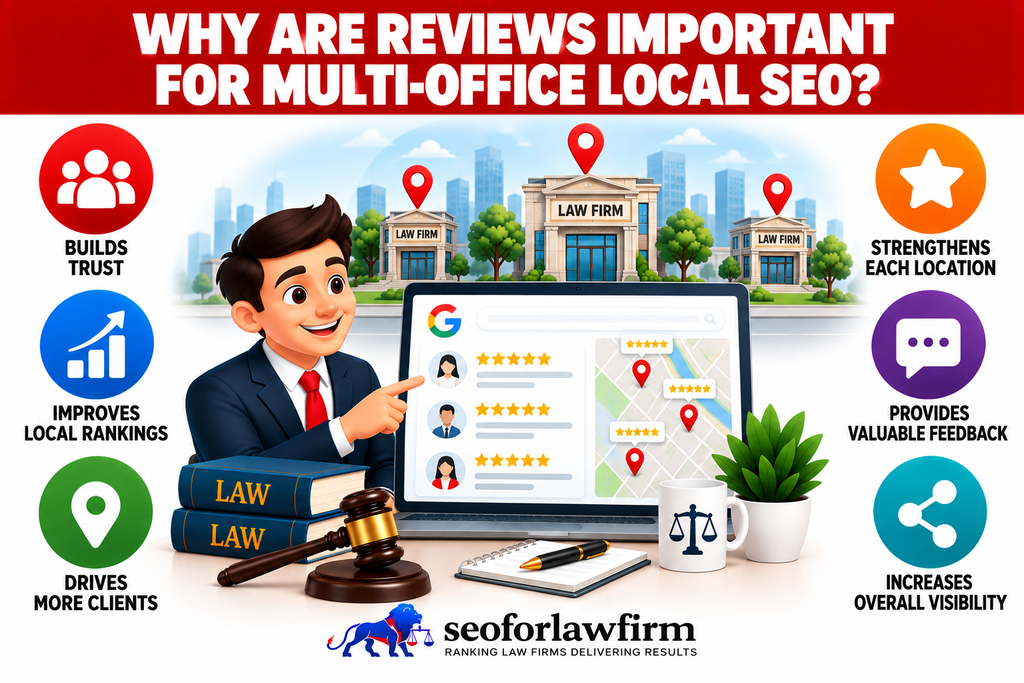
Why Are Reviews Important for Multi-Office Local SEO?
Reviews are important for multi-office local SEO because they give each office independent client feedback, influence prospective-client decisions, and contribute to the prominence signals Google uses in local ranking. Multi-office firms must route each review request to the Business Profile of the office that actually served the client, such as directing a Dallas client to the Dallas profile and a Houston client to the Houston profile. According to a study by Davide Proserpio and Georgios Zervas titled Online Reputation Management: Estimating the Impact of Management Responses on Consumer Reviews in 2017, Proserpio and Zervas estimated a 0.12-star rating increase and 12% more reviews for responding hotels. Law firms must separately consider confidentiality before adapting this hospitality finding. Law firm reputation management connects office-level review monitoring with response responsibilities and recurring client-service issues.
Automated workflows send the correct review link after an eligible client interaction, but the request must remain neutral and must not offer incentives for posting, changing, or removing feedback. Law firms must also protect client confidentiality and follow applicable professional-conduct rules when requesting or responding to reviews. Reviews must reflect genuine client experiences rather than artificially inserting city names, practice-area keywords, or attorney names into the feedback.
How Can Internal Linking Strengthen Multi-Office SEO Structure?
Internal linking strengthens multi-office SEO by connecting office pages, practice areas, attorney profiles, and the firm’s location hierarchy. These links help users and search engines understand how the pages relate. A locations hub links to each genuine office, office pages link to services available at that location, attorney profiles link to the offices where those lawyers work, and practice-area pages link to offices that provide the service.
Nearby office pages also link to one another when the relationship genuinely helps clients. Internal links support page discovery and pass PageRank through the website, but they do not distribute third-party metrics such as Domain Authority or Domain Rating. A complete law firm internal linking strategy must therefore connect relevant offices, attorneys, and services without creating repetitive or artificial cross-linking.
How Does SEO Work for Multiple Cities?
SEO for multiple cities works by creating useful location-specific pages for real offices or genuinely distinct geographic service areas. Each page must reflect the firm’s actual relationship with that market and must not falsely imply that the firm maintains an office where none exists. City pages need independent value rather than near-duplicate content created only to target geographic keyword variations. The choice between national and local SEO depends on where the firm can accept matters and whether clients search for a nearby office or a wider-area practice.
Listed below are the 8 main elements that differentiate multi-city SEO pages.
- Actual office information
- Attorneys serving the market
- Courts and procedural context
- Applicable jurisdictional information
- Service availability
- Local client resources
- Genuine directions and access information
- Distinct contact options